
Eiusmod tempor incididunt ut labore et dolore magna aliqua. Quis ipsum ultrice gravida isus commodo viverra.
News Feed


- Mon - Thu: 7:00am – 2:00pm / 4:45pm Fri: 7:00am – 11:15pm / 1:30pm
- +971 3 761 2204
- 10th Street, Falaj Hazza, Al Ain, UAE
Eiusmod tempor incididunt ut labore et dolore magna aliqua. Quis ipsum ultrice gravida isus commodo viverra.
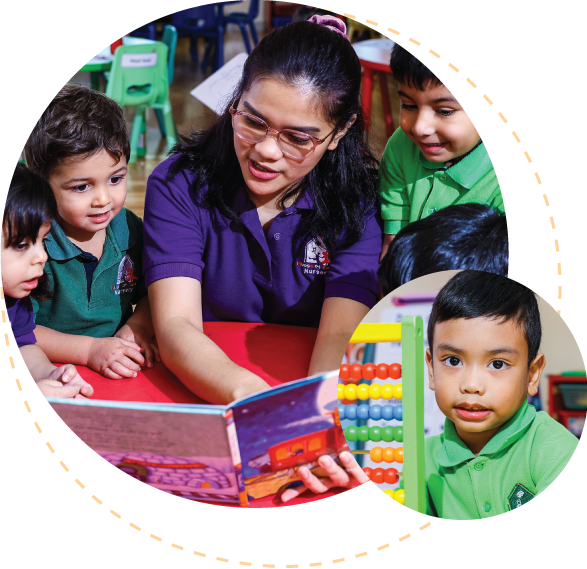
The Early Years Foundation stage is the early years curriculum guidance, that we follow to support your children develop in all areas.
The following 4 themes underpin all the guidance:


These are the fundamental building blocks which support all other areas of development and include
1. Personal, Social and Emotional Development:
Children’s personal, social and emotional development (PSED) is crucial for children to lead healthy and happy lives, and is fundamental to their cognitive development. Underpinning their personal development are the important attachments that shape their social world. Strong, warm and supportive relationships with adults enable children to learn how to understand their own feelings and those of others.
Through supportive and warm relationships, practitioners can help to support children with managing their emotions and developing a positive sense of self, encourage them to have confidence in their own abilities. Children are encouraged to persist when activities are challenging and to develop the patience needed in order to wait for what they want.
Additionally includes practitioners helping children to gain an understanding of how to keep their bodies healthy, including healthy eating, and to help support them with managing their personal needs so that they can do this independently over time.
Friendships with other children form another important aspect of PSED with practitioners needing to help EYFS children with their interactions and provide them with the skills that they need in order to resolve conflicts effectively.
2. Communication and Language
Children’s back-and-forth interactions from an early age form the foundations for language and cognitive development.’
With this in mind, the statutory framework for the EYFS recognizes that a critical element of communication and language development is the interactions and conversations children have with practitioners and peers within a ‘language-rich environment’. It’s important that these conversations are both high quality and frequently occurring. Our teachers are trained to ask Open-ended questions like
How can we find out? What made you think of that? Why do you think that happened? What could you change? Instead of close-ended questions like what is this? Where do you get this?
3. Physical Development
Physical development consists of two elements: Gross Motor Skills and Fine Motor Skills. The statutory framework for the early year’s foundation stage states that:
‘Gross motor skills provide the foundation for developing healthy bodies and social and emotional well-being. Fine motor control and precision helps with hand-eye co-ordination, which is later linked to early literacy.’
During early years, it’s important to provide activities that support children’s gross motor development, both indoors and out. This will additionally help to develop children’s core strength; an important factor to successfully developing effective gross motor skills.
Whilst gross motor development involves larger body movements, fine motor development involves the smaller, more precise movements of the hands, wrists, and fingers. Fine motor skills are needed for activities, such as fastening buttons, writing skills and effectively cutting with scissors.
These include essential skills and knowledge which enable children to participate successfully in society.
These develop effectively when the Prime areas are thoroughly embedded.
1. Numeracy:
The early learning goals for mathematics.
At the end of the reception year, children are assessed against the early learning goals (ELGs). There are two elements for the mathematics ELGs, number and numerical pattern. The mathematics ELGs are as follows:
ELG: Number
Children at the expected level of development will:
Emergent:
2. Literacy:
As the earliest stage of literacy development, emergent literacy is the first moment that a child begins to understand letters and words. At this stage Emerging Learners
Jolly Phonics: In order to support emerging readers by helping them understand alphabet knowledge and phonological awareness House of Colours Nursery introduces the letters through the much acclaimed Jolly Phonics.
Children start off by recognizing that print holds meaning. Though they can’t decode the printed words, they retell stories in their own words as they turn the pages of their little books. They comment on the illustrations and discuss what they like or notice in the stories.
The students are developing some phonemic awareness skills, including the ability to rhyme and use alliteration. They recognize some common words in environmental print, like the names of their favorite restaurants. Some students in the class are beginning to recognize printed letters and identify their related sounds.
Techniques used during read- aloud: During a read-aloud, the teacher holds the book upright and points out the author and illustrator. She models how to turn the pages, and she points to each word as she reads, showing the one-to-one correspondence between the written and spoken word. To model reading from left to right, she follows along with her finger, moving to the sentence below when she reaches the end of each line.
She engages in word play frequently, reads poems and nursery rhymes, and asks students to form rhyming pairs. She asks what sounds students hear at the beginning and ending of a word, and she begins introducing them to letter names and sounds.

Pre-Writing and writing Skills:
Pre-writing skills are the fundamental fine motor skills that children need to develop before they begin to write. Pre-writing skills help your child build finger strength, eye hand coordination, wrist movement and grip strength.
At House of Colours Nursery mark making and prewriting skills are developed through play way method:
Playdough, Cutting patterns, Water paint, Scoop and pour, Ball throwing games, Squishy bags, Bubble wrap etc.

Expected Child Milestones for pre-writing
1-2 years
Imitate a vertical line
Scribble in a vertical or horizontal motion
2-3 years
Imitate/Master a horizontal line
Imitate/ Master a vertical line
Imitate a circle shape
3-4 years
Master horizontal and vertical lines.
Imitate the shapes of circle and square and cross shapes (+)
3. Understanding the World
It involves guiding children to make sense of their physical world and their community.
The frequency and range of children’s personal experiences increases their knowledge and sense of the world around them – from visiting parks, libraries and museums to meeting important members of society such as police officers, nurses and firefighters.
In addition, listening to a broad selection of stories, non-fiction, rhymes and poems will foster their understanding of our culturally, socially, technologically and ecologically diverse world. As well as building important knowledge, this extends their familiarity with words that support understanding across domains. Enriching and widening children’s vocabulary will support later reading comprehension.
Encouraging Emarati Identity: Kandura, abayah, Dallah, coffee, dates, camel milk, harees, fouga, kabsa and luqemat. All that denotes and represents the identity and leadership of this country is an active part of inclusion in our curriculum. Sheikh Zayed’s vision of making this country number one in everything is paramount in House of Colours Nursery vision.
Following this vision House of Colours Nursery have teamed up with Ajmal Hassan an Environment Specialist in Mleiha Archeological Center to incorporate Emarati Flora and Fauna in its curricula. Instagram: ajmal.hasan

4. Expressive Arts and Design
Expressive arts and design encompasses a wide breadth of creative areas, such as listening and responding to singing and performing, experimenting with colour mixing and different textures, creating models (for example, junk modelling), small world play, building and construction, and role-play activities.
Children taking part in expressive arts and design activities in early year’s settings gain many valuable skills as these types of activities help to support children’s creativity and imagination, allows children to explore different materials, media and sounds, as well as helping to build children’s confidence in their own ideas and opinions.
Testimonials are a way for our parents to express their feelings and appreciation towards our Nursery, please read some of our parent testimonials.
Both of my children attend the nursery, and they are genuinely happy, excited to learn, and absolutely love going to school every day. That alone says everything as a parent. Mrs. Grace is truly the heart and anchor of this wonderful facility. Her care, leadership, and dedication can be felt throughout the entire nursery. Every teacher has made such a positive impact on my children, and they speak about them with so much love and happiness.DL is not ideal for anyone, and as parents our wallets may not always be happy either. However, we also understand that these decisions are beyond the nursery’s control and come from the MOE/ADEK regulations that everyone must follow. The nursery still has staff, responsibilities, and families to support as well. The team is thinking outside the box and doing everything they can to make the situation as balanced and manageable as possible for everyone involved. That level of effort and care deserves recognition and support. Thank you, House of Colour Nursery, for helping prepare my children for the next stage of their journey, academically, socially, and emotionally. We fully support and appreciate all that you do.
As a parent of twins, I know it’s not always easy to understand how to care for and treat twins as individuals, but the team here truly does an amazing job. The staff are warm, patient, and genuinely caring. They understand each child’s personality and make sure both of my little ones feel safe, happy, and engaged every day. I’ve seen such positive development in their confidence, communication, and social skills. A special thank you to Ms. Grace, the Principal, for her exceptional leadership and thoughtful communication, which truly reflect the nurturing and high quality environment she has built. It gives me real peace of mind knowing they are in such a supportive and enriching setting. I’m truly grateful to the entire team for their dedication and care. Highly recommended for any parent looking for a professional and caring nursery.
I have seen first-hand the amazing impact this nursery has had on my niece and nephew over the past two years. Their growth and development have been incredible and they have learned so much, both academically and socially, in such a short time. What stands out the most is how much they love going to school. They talk about their teachers with excitement and affection, which says a lot about the level of care and attention they receive every day. Ms. Grace and her team clearly go above and beyond to create a warm and supportive environment where children feel happy and comfortable. Even during distance learning, the team made a real effort to stay connected. They surprised the children at home, which brought the kids so much joy and showed how dedicated they are to maintaining strong relationships with the kids. I have also attended a few of their events, and they have always been engaging and fun for both children and families. I highly recommend this nursery to anyone in Al Ain looking for a caring and supportive environment for their children.
House of Colours goes out of their way to accommodate and take care of the children. Their fun and family days are well organized and so much fun for the kids. During the distance learning periods, they have visited the children in their homes and arranged for meetups. They have done a great job of making the children feel they are part of a larger family. I highly recommend them.